Create an interactive infographic to help social media audiences uncover whether US military actions in Venezuela meet the legal threshold for war crimes.
Mission Dossier
Did the US military commit a war crime or break any international laws when bombing alleged drug boats in international waters and/or when conducting Operation Absolute Resolve in 2025-2026?
After bombing several alleged drug boats in international waters and even conducting a "double tap" strike, which killed survivors, President Trump launched Operation Absolute Resolve, where the US Armed Forces invaded Venezuela, killed approximately 50 soldiers, forcibly removed President Maduro, and occupied the country indefinitely, at least in part to have access to Venezuelan oil.
US officials have justified their actions by claiming they were fighting drug cartels, overturning an illegitimate leader, and protecting US interests, but some alleged that these actions are illegal under international law and may even be war crimes. International law has specific definitions for terms like "war crimes", and institutions like the International Criminal Court (ICC), International Court of Justice (ICJ), Inter-American Commission on Human Rights (IACHR), and the United Nations (UN) exist to enforce international law… at least in theory.
Teachers in US public schools face various formal and informal restrictions when it comes to criticizing the actions of the US government or military, or talking about a partisan issue in the classroom. But understanding what actions violate international laws, and why powerful nations rarely face accountability, is vital for the next generation of leaders, because a realistic understanding of international justice is the first step towards advocating for more equitable global reforms.
Providing an interactive infographic allows educators and activists share this information on social media in a quick but engaging learning format. This infographic will be vertically oriented, so that it’s optimized to be viewed on a phone, and will consist of multiple components that people can scroll through and interact with.
This package is for educators and activists who want to share educational content on social media. Try to keep the readability at or below an 8th-grade level.
Package: You will create a single, tall, multi-component interactive infographic using the free version of Genially or another similar tool.
Goal: The goal is for social media audiences to be able to scroll through and interact with the infographic on their phones. The infographic will present the legal framework for war crimes and other violations of international law, and apply that to specific US actions in Venezuela.
Tone: Clear, factual, educational. Avoid inflammatory language. Let the facts do the work.
Images: Only use images you create or that do not require attribution. If using stock icons or illustrations, use sources like Unsplash, Pexels, Pixabay, or Freepik. MFU has a paid Freepik account — reach out to your handler if you need premium assets. In accordance with MFU policy, if you use any AI-generated images, include a disclaimer on the infographic.
Required components:
- Title: Create an engaging title that connects Operation Absolute Resolve and the US’s bombing of alleged drug boats to international law.
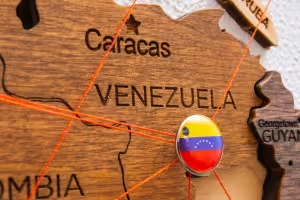
- Interactive Map: Show Venezuela’s location with relevant geographic features labeled. Make Venezuela clickable to provide a brief pre-intervention context.
- Interactive Timeline: Display key events from Operation Absolute Resolve and the bombing of alleged drug boats. Make each event clickable for details about what happened.
- Interactive Flashcards: Create an interactive flashcard set with about 10 international law terms that may or may not apply to the US’s actions. On the front, place the term and definition. On the back, place real or fictional examples of actions that could be defined with that term. Terms could include war crime, crime of aggression, violation of sovereignty, pillaging, crime of aggression, illegal use of force, violation of sovereignty, human rights violation, etc. Prompt the student to look at the definitions and examples and judge for themselves whether each term matches one or more of the US’s actions.
- Interactive Flow Chart: Display blocks for each international institution (ICC, ICJ, IACHR, UN) with brief descriptions of their mandates. Arrows from each block point to a US symbol. Click any arrow to reveal what enforcement powers that institution has (or doesn’t have) against the US.
- Call to Action: To conclude, call out the accountability gap explicitly and how it creates “might makes right” situations. Prompt to share the infographic. Provide links to find out more and support one or more organization is are working on international law reform.
- Footer: Include MFU logo in the footer and a link to the homepage (www.myflinguniversity.org). Optionally, include your name or alias as the author.

Essential skills:
- Ability to extract key points from complex source material
- Keen eye for contradictions between claims and evidence
- Clear sense of how to organize dense information into a visual format
- Basic visual layout skills, including hierarchy, spacing, and flow
- Willingness to learn Genially’s drag-and-drop interface
NOT required:
- Law degree or legal expertise
- Advanced graphic design skills or paid software
- Illustration ability (can use stock graphics, icons, simple shapes)
You are welcome to use these sources to help you get started. Please note that some are more fact-based, while others are opinion articles:
- U.S. strikes on alleged drug boats: What we know (NPR, Nov 2025; updated Feb 2026): Comprehensive, continuously updated tracker of every U.S. strike on alleged drug boats since September 2025, including dates, death tolls, and administration claims.
- 2025 U.S. Strikes on Venezuelan Vessels (Britannica, Oct 2025): Encyclopedic overview with map and chronological timeline of strikes, key statements from both governments, and summary of legal questions raised by international observers.
- Trump bombs Venezuela, US abducts Maduro: All we know (Al Jazeera, Jan 2026): Running account of Operation Absolute Resolve, from the bombing of Caracas to Maduro’s abduction and detention in New York, including international reactions and Trump’s claim the U.S. will "run" Venezuela.
- How the U.S. captured Maduro in Venezuela: A CIA team, steel doors and a fateful phone call (NBC News, Jan 2026): Detailed reconstruction of the planning and execution of Operation Absolute Resolve, including months of CIA intelligence gathering, Delta Force rehearsals, and Trump’s final phone call to Maduro.
- Nearly 50 Venezuelan soldiers killed in US abduction of President Maduro (Al Jazeera, Jan 2026): Updated casualty figures from Venezuela’s Defence Ministry reporting 83 total killed, including 47 Venezuelan troops and 32 Cuban soldiers assigned to Maduro’s protection.
- Expert Q&A on U.S. Military Actions on Venezuela and Boat Strikes (Just Security, Dec 2025; updated Jan 2026): Comprehensive legal FAQ analyzing the boat strikes, Operation Absolute Resolve, and the seizure of Maduro under international humanitarian law, human rights law, and U.S. domestic law. This is the most detailed legal analysis available.
- International Law and the U.S. Military and Law Enforcement Operations in Venezuela (Just Security, Jan 2026): Expert survey of international law issues raised by the Maduro capture, including violations of sovereignty, the triggering of an international armed conflict, and implications for the broader legal order.
- Trump says U.S. is "in charge" of Venezuela, Maduro jailed in New York after U.S. military operation (CBS News, Jan 2026): Live reporting hub covering Maduro’s detention, Defense Secretary Hegseth’s comparison to Iraq, Trump’s statements about controlling Venezuela’s oil, and domestic political reactions.
- The twisted reason why Trump is bombing Venezuelan boats (Vox, Dec 2025): Opinion analysis arguing the boat strikes were less about drug trafficking and more about pressuring Maduro, examining the "double tap" strike controversy and the administration’s broader disregard for laws of war.
If you’re using Genially:
- Once you’ve created a free Genially account, you can search for “mobile infographics” templates, such as this one, to get you started.
- Or, you can select the purple button in the upper right corner of your home screen, click on “Blank Creation”, and begin with a blank canvas.
- If you need help, you can click on the question mark in the lower right corner or go to the Genially help center.
For general questions, contact @Owlett on Discord or email info@myflyinguniversity.org.
If you have an idea for a different approach to all or part of this mission, please feel free to reach out before you get started!
- The infographic includes all 7 required content sections in logical order.
- Hotspot buttons and other interactives function correctly.
- Map and background information about Venezuela are accurate.
- Timeline includes accurate dates, actions, and details.
- Flashcards have correct definitions and reasonable examples.
- The flowchart provides accurate information about enforcement powers.
- The call to action provides a good conclusion and contains working links.
- All information provided is factually accurate (no misstatements of international law).
- The elements of the infographic flow together with transitions as needed.
- Design is mobile-optimized, visually clear, and maintains consistent styling.
- Text is readable at typical mobile zoom levels.
- Images and icons are properly sourced (Creative Commons, public domain, or original).
- MFU logo and link included.
What to submit (from your MFU dashboard):
- Copy and share the link to the live Genially infographic. Make sure it’s set so that anyone with a link can see it.
- Copy and share the embed code for the infographic. From the share menu, select “see all”, click the “script” button, and then select the “copy” button.
- Upload an accessibility document with a text description of what is shown in the infographic.
- Upload a list of any external images used, along with their links or license information.
There is no hard deadline for this mission, but you will need to provide a status update once a week on your MFU dashboard.
This mission is available!
Accept This Mission