Corruption isn’t new. But the tools keep changing.
In the 1870s, Boss Tweed turned New York’s city government into a money-making machine for himself and his allies, selling access, rewarding loyalty, and rewriting the rules to protect the grift.
Fast forward to today, and the currency of corruption looks a little different. It’s digital. It’s meme-friendly. And it’s branded with the name of the President of the United States.
The $Trump Coin may sound like a joke, but the mechanics echo a familiar pattern: money for access, perks for loyalty, and profit for the powerful.


Modern Case Study: The $Trump Coin
What if buying access to the President didn’t mean campaign donations or backroom deals, but simply buying the right cryptocurrency?
In early 2024, a meme-based cryptocurrency called $Trump Coin launched with official branding and licensing from then-candidate, now-President Donald Trump. Marketed as both an investment opportunity and a loyalty badge, the coin offered buyers the chance to win real-world perks, like VIP dinners or photo ops with the president.
It might look like a publicity stunt, but the incentives are serious: the more coins you buy, the higher you climb on the official MAGA leaderboard. The top spenders get a chance to win prizes, including in-person events with Donald Trump, such as VIP dinners or photo ops.
That’s not speculation. That’s the actual sales pitch.
You can view it on the official Trump Coin website.

The coin is backed by a private company, CIC Digital, which licensed Trump’s name and image for an undisclosed amount. While the exact size of Trump’s personal payout hasn’t been confirmed, Reuters and other outlets report that CIC Digital and related entities collected in trading fees within weeks of launch. Broader estimates suggest that total revenues from trading fees and related sales have since
Critically, this isn’t campaign fundraising. These are private, anonymous transactions that are not subject to donation limits, financial regulations, or transparency laws. That opens the door to potential influence-buying from foreign nationals, shell companies, or lobbyists with undisclosed agendas.
And, because buyers can remain anonymous, there are no clear restrictions on who is purchasing influence (or why).


The structure matters. Buyers spend money on a product marketed as entertainment or merch. But the reward system tied to spending, including exclusive access to a sitting president, makes it functionally indistinguishable from a pay-to-play system. The more you spend, the closer you get to power.
What’s more, data shows that while 58 early investors made millions, over 700,000 investors have lost money.
Critics have accused Trump of orchestrating a pump-and-dump scheme, where insiders hype the coin, drive up prices with exclusive perks, then cash out as the market collapses around late buyers.
And just as watchdog groups began raising alarms, Trump allies in Congress introduced the GENIUS Act, which passed with the support of 16 Democrats and most Republicans.
This bill shifts oversight of cryptocurrencies away from the Securities and Exchange Commission (SEC) into the ands of a new commission under the control of the Executive Branch. This would create a serious conflict of interest, where the president oversees the same market he is profiting from.
Senator Elizabeth Warren (D-MA) has been one of the most vocal critics of the GENIUS Act and the $Trump Coin scheme.
In this short video, she explains exactly why she voted against the bill and what’s at stake when the president profits from a market he could soon control.
Let’s be clear… this isn’t just a weird stunt or a cringeworthy novelty token. It’s a direct pipeline between money and access, designed to bypass campaign finance laws, disguise political patronage as digital fandom, and turn influence into a speculative commodity.
When you can profit from public power and write the rules that protect your profits, that’s not governance. It’s a blueprint for legalizing grift and corruption at the highest level of government.
Let’s be clear: this isn’t just a gimmick or a novelty coin. When financial contributions to a branded cryptocurrency are tied to access to the nation’s highest office, we’re no longer talking about satire. We’re talking about a new form of political influence that’s faster, less transparent, and harder to regulate.
Click Here To Go Deeper: Is Any of This Legal?
“This might be the most staggeringly corrupt thing that any president has ever done. And it’s not even close.”
In this legal analysis, attorney and professor Devin Stone (aka LegalEagle) examines the $Trump Coin through the lens of U.S. law. He explores whether offering exclusive access to high-dollar crypto buyers could violate anti-bribery statutes or the Constitution’s emoluments clauses, which prohibit personal enrichment through the presidency.
While the law hasn’t fully caught up to cryptocurrency politics, the questions raised here are essential for anyone studying the evolving relationship between power, money, and legal oversight.
Click Here To Go Deeper: What Happened at the Trump Coin Dinner?
“Trump came, gave a speech for like, probably 23 minutes… and then he left. I am very disappointed with the dinner.”
This Wall Street Journal investigation looks beyond the headlines to examine one of the first $Trump Coin events: a private gala dinner for top-tier coin holders. The video captures not only what attendees expected, but what they actually got.
Some guests were drawn by status. Others were there to network. But critics argue the event blurred the line between digital fundraising and political access. The WSJ report gives us a chance to observe how influence is marketed in the cryptocurrency age, and how spectacle can be used as a substitute for substance.
Click Here To Go Deeper: More Examples of Corruption
“Because, what President Trump is trying to do is engage in so much public corruption that you just become normalized to it, that you stop paying attention to the corruption.”
In this video, Senator Chris Murphy (D-CT) outlines 40 examples of what he views as ethically questionable behavior during the early months of President Trump’s second term.
Whether or not you agree with every claim, the underlying warning is a powerful one: when corruption becomes constant, it can start to feel invisible. This segment opens the door for discussion about what kinds of actions cross ethical lines, how we define political corruption, and how democratic systems can lose the ability to hold leaders accountable.
Historical Case Study: Boss Tweed and Tammany Hall
In the 1870s, William “Boss” Tweed turned New York City into one of the most profitable criminal enterprises in American political history.
As the head of Tammany Hall, the city’s powerful Democratic political organization, Tweed built a network that extended into nearly every corner of public life, involving judges, contractors, city clerks, and councilmen. His influence didn’t come from policy. It came from patronage, bribes, and control over public funds.
And it worked. For a time.
How He Lined His Pockets
Tweed didn’t just exploit the rules. He helped write them. His operation inflated city contracts, most famously during a courthouse project that ballooned from $250,000 to over $12 million (about $200 million today). Contractors overbilled for everything from marble to mops, and the excess flowed back to Tweed’s allies as kickbacks.
His team also padded payrolls with ghost employees, forced real workers to surrender portions of their wages, and strategically bought land that would skyrocket in value thanks to taxpayer-funded projects
The result: a closed loop of profit, loyalty, and silence.
To keep control, Tammany Hall rigged elections through ballot stuffing, repeat voting, and intimidation, ensuring the money kept flowing and Tweed’s Ring stayed in power.

Boss Tweed, Nast.jpg. Thomas Nast, Public domain, via Wikimedia Commons
Click Here To Go Deeper: Who Was the Real Boss Tweed?
“For the amount of chair money that Tweed actually billed the city for, they could have bought around 315,000 of them—and that’s somewhere around 17 miles of chairs.”
In this sharp and accessible biography, Simon Whistler walks through the life of a man who turned city government into a personal piggy bank. From crooked construction contracts to vote-rigging and outright theft, the video shows how one political boss captured a city’s entire operating system.
This video offers a clear look at how structural power, weak oversight, and public apathy can turn governance into grift.
Click Here To Go Deeper: Tammany Hall and the Machinery of Power
“Vote early and often. With or without your beard.“
In this chaotic and insightful explainer, the Griffiths break down how Tammany Hall became the blueprint for urban political machines. They trace how fear, favors, and fraud created a system that rewarded loyalty and punished dissent, all while lining the pockets of those at the top.
The video reveals how democratic systems can be manipulated to serve insiders, and how public trust can be sold off piece by piece when no one is watching too closely.
Click Here To Go Deeper: A Crash Course on Gilded Age Politics
“It was wonderful to see my men slug the opposition to preserve the sanctity of the ballot.”
John Green unpacks the Gilded Age’s glittering surface and corrupt core, showing how economic growth coexisted with vote fraud, bribery, and backroom deals. He highlights the institutional decay that set in when politicians used public office as a business venture.
The video serves as a reminder that systemic corruption isn’t just about individual bad actors. It’s about designing systems that allow them to thrive.
Activity: Who Did It — Trump or Tweed?
Corruption doesn’t always wear the same costume. Sometimes it shows up in backroom deals and phony invoices. Sometimes it wears a red tie and owns a hotel.
In this activity, you’ll examine a series of real political corruption scandals. Each one actually happened, but was it the work of a 19th-century political boss, or a 21st-century president?
Be it a courthouse or a hotel, a fake invoice or a hush payment, the tools of corruption change, but the tactics stay familiar. By comparing the past and present, we can spot the warning signs before the damage is done.
Core Pattern: Grift Thrives When We Look Away
We’ve been here before.
Boss Tweed’s corruption wasn’t a secret. It was an open joke, whispered in bars and shouted in the streets. But he remained untouchable for years because he controlled the levers of power: the courts, the city treasury, even the people counting the ballots.
For a while, it seemed like no one could stop him.
But power built on fraud is never as stable as it looks. Pressure started to build. People began asking questions. Records surfaced. The story started to shift.

“What Are You Laughing At? To the Victor Belong the Spoils” (from Harper’s Weekly). Thomas Nast, CC0, via Wikimedia Commons.

AI-generated image of “Trump: Long Live the King”, from a tweet by the official White House account. White House, Public domain, via Wikimedia Commons.
Today, we’re seeing echoes of that same playbook.
A powerful figure surrounds himself with loyalists, uses public office for private gain, and rewrites the rules to protect himself. The corruption isn’t subtle. It’s part of the message: “Wealth is power, and power can’t be questioned.”
But history shows that exposure matters. Tweed held the courts, the treasury, and the ballots, but he couldn’t control the narrative forever. When the right people pushed back in the right way, the truth started to spread.
And one of the most powerful tools wasn’t a law or a lawsuit. It was a picture.
Lesson From the Past: The Nast-y End of Boss Tweed
Thomas Nast didn’t have subpoena power. He didn’t hold office. He couldn’t order an investigation or seize records.
But he could draw.
As a political cartoonist at Harper’s Weekly, Nast turned complex corruption into simple, unforgettable images. He portrayed Tweed as a bloated bag of money, surrounded by vultures and seated on piles of stolen gold.
His cartoons made the story impossible to ignore, even for people who couldn’t read the editorials.
“What Are You Laughing At? To the Victor Belong the Spoils” (from Harper’s Weekly). Thomas Nast, CC0, via Wikimedia Commons.
Tweed once famously said:
“Stop them damn pictures! I don’t care so much what the papers write about me. My constituents can’t read. But, damn it, they can see pictures.”
The message spread faster than the paperwork ever could. Nast’s drawings reached new audiences, fueled public outrage, and helped turn the tide.
Want to see how a cartoonist helped bring down a corrupt political empire?
This collection of 33 high-res images shows Thomas Nast’s most iconic illustrations targeting Boss Tweed. The images come from John Adler’s book America’s Most Influential Journalist and Premier Political Cartoonist.

Nast’s work fueled public outrage, emboldened reformers, and helped flip public opinion so powerfully that, with the help of a scrupulous auditor, Matthew J. O’Rouke, Tweed was eventually arrested, tried, and imprisoned.
Modern Tactics: Fight Back Like Nast
Today, we face a different era, but a familiar pattern persists. A powerful figure is surrounded by loyalists, using public trust to fuel private gain, and rewriting the rules to protect himself. The $Trump Coin isn’t just a grift. It’s a test of whether people will speak out, stay loud, and push back before the damage becomes irreversible.
You may not be a professional artist, but with modern technology, you can do what Thomas Nast did. You don’t even have to be able to draw: you can create memes with a few clicks.
The photos below are all from the official gallery at whitehouse.gov. Apparently, these are some of the most FLATTERING images of Trump that the White House staff could find. But, don’t worry; most of them lend themselves to satire. Let’s use the Whitehouse propaganda photos to highlight how ridiculous this political situation has become.
You don’t need to be a professional artist to call out corruption. Thomas Nast used ink and paper. Today, you’ve got memes.
Nast’s cartoons helped the public see what the text of corruption reports couldn’t. They were bold, simple, and hard to ignore. Memes can do the same.
The official White House photo gallery includes carefully staged images designed to promote power. Your job? Use one to tell a different story.

Choose any image from the White House photo gallery, then head to Imgflip to create your meme. Add a caption that challenges the message, reveals what’s being hidden, or reframes what’s being sold.
If you’d like, share your creation on our subreddit and help others see what you see.
Take Action: Call Out the Corruption
This isn’t just about memes.
If you’re frustrated, angry, or just tired of watching corruption play out in plain sight, there’s something simple you can do: make a call.
Your representatives work for you. They need to hear when you see something broken.
Start here: 5 calls makes it quick and easy. Type in your zip code to get phone numbers and scripts for your elected officials.
Not sure what to say? We’ve got a script focused on the GENIUS Act and financial conflicts of interest. Use it, change it, or just speak from the heart.

CLICK FOR SCRIPT: ANTICORRUPTION AND THE GENIUS ACT
Hello, my name is [Your Name], and I’m a constituent from [City, ZIP Code].
I’m calling to express serious concern about President Trump’s personal financial involvement in the $Trump Coin cryptocurrency, and the role the GENIUS Act plays in removing oversight of crypto markets.
As it stands, this setup allows the president to profit directly from a volatile financial asset while offering access to the highest bidders—without transparency, donation limits, or accountability.
The GENIUS Act makes this worse by weakening the SEC’s role and placing crypto regulation under direct presidential control. That’s a blueprint for unchecked abuse.
I urge [Representative/Senator’s Name] to support legislation that restores oversight, opposes self-dealing from public office, and closes the loopholes that let anonymous investors—including foreign interests—buy influence.
Please speak out publicly against this corruption, and do everything in your power to reinstate strong financial ethics and transparency standards.
Thank you for your time and service.
Resources to Share
Want to introduce this issue to people with limited attention spans for politics? Consider these resources.
Shareables for Overwhelmed and Underinformed Voters
Infographics and interactives are a way to engage citizens that don’t have the time or patience to read or watch the news.
Senator Chris Murphey posted this infographic on Twitter on April 30th, mapping what he described in his recent speech as 40 examples of corruption in the first 100 days of Trump’s second term.
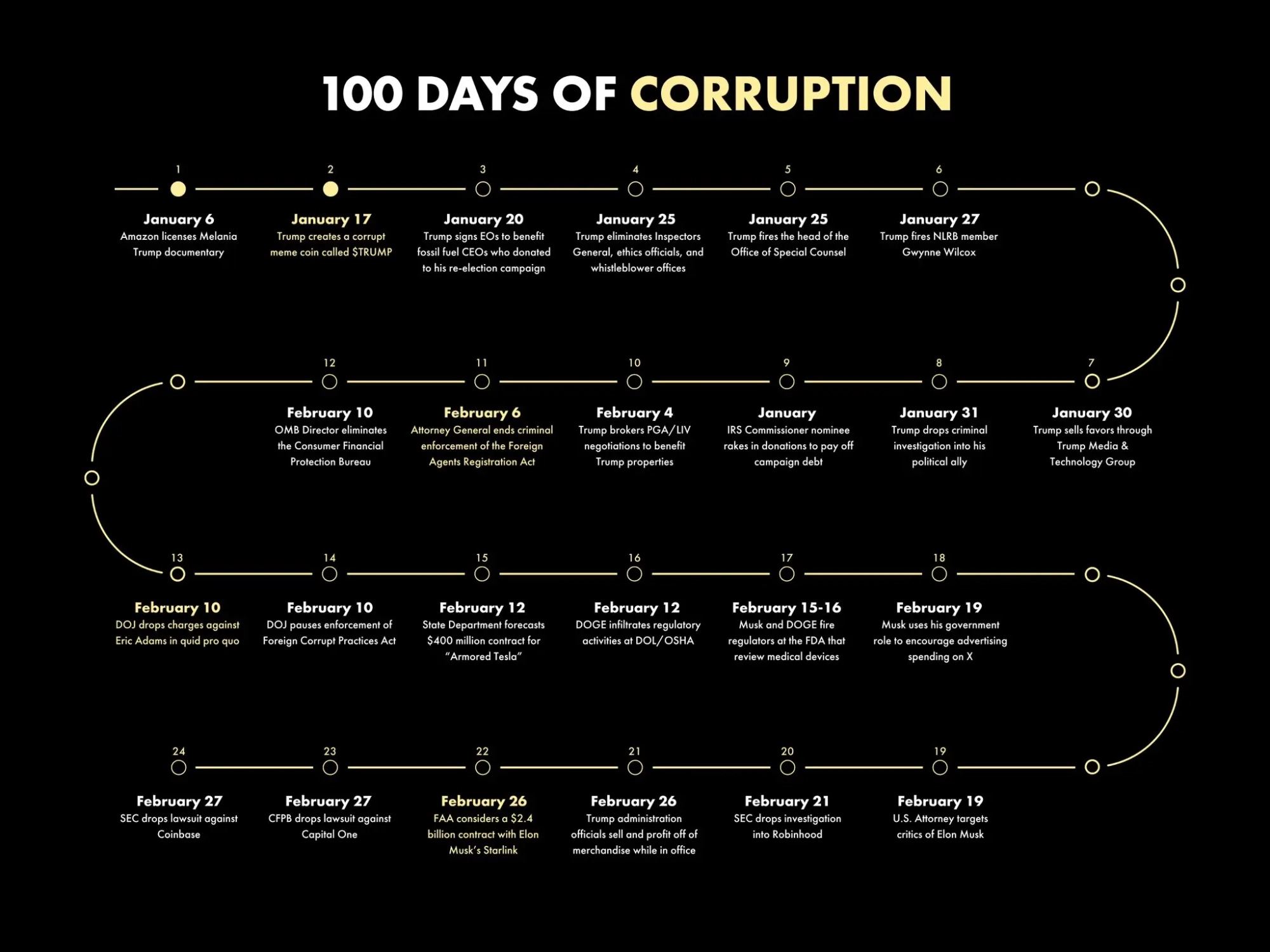
You can also click here to see an interactive from the Democracy Labs that allows you to click on icons to learn about 20 reported Trump Grifts to learn more about them.

Shareables for Kids
TED-Ed’s Democracy Lab is a great resource for parents and teachers looking for a way to lead into talking about present-day political issues. They also provide additional resources for teachers who want to use the videos in their classrooms. You can view the videos on YouTube or straight from the TED-Ed website.
This TED-Ed video corruption in the modern era, without setting off alarm bells for nervous school districts.
Shareables for Folks Who Only Watch Fox News
Because it’s under the Fox News Network branding, Fox Business News is seen as credible by many conservative and pro-Trump viewers. But, since it focuses more on economics and policy than on culture war issues, it may be a good source to look to when trying to reach across the aisle. If someone hears about corruption or conflicts of interest from a source they trust, especially one that emphasizes how it could hurt their wallets or communities, they may be more open to rethinking what’s happening.

Here’s an article about the original release of the $Trump Coin that echos some of the same data from other news sources about the personal financial benefit to Trump and his family, and potential conflicts of interests:
President-elect Trump launches own cryptocurrency meme coin ahead of inauguration
You might also look for coverage from right-wing news sources that include audio or video of Trump speaking in his own words.
Here’s an article and video of Trump stating, in 2021, that cryptocurries seem like a scam, hurt the US currency, and should be highly-regulated:
Trump warns crypto ‘potentially a disaster waiting to happen’
Self-Check: Audit Yourself
You may now complete a short quiz on this topic. Please answer honestly, ironically, or while muttering “we live in a society.”
.
Cool Down: A Corrupt Little Ditty
To wrap things up, enjoy this short and savage retelling of Boss Tweed’s downfall, performed by actor and author John Lithgow. It’s based on his book A Confederacy of Dumptys, which turns America’s worst political disasters into pointed little poems.
This one’s about Tweed. His rise, his theft, and the strange little coalition that finally took him down.
Tweed thought he was untouchable… until he wasn’t. No system is so entrenched that it can’t be challenged. No grifter is so big that they can’t fall.