In the 1870s, Boss Tweed used Tammany Hall to sell access, reward loyalty, and steal millions from the public.
Today, we’ve got $Trump Coin, a meme currency that funnels money directly into a presidential pocket.
The prize? Power, proximity, and influence.
The rules? Written by the guy holding the bag.
Corruption didn’t disappear. It just got digitized.


Modern Issue
What’s Happening Now?
What if buying access to the President didn’t mean campaign donations or backroom deals, but just buying the right crypto?
Enter $Trump Coin, a meme-based cryptocurrency launched in spring 2024, marketed to supporters as both an investment and a loyalty badge.
It looks like satire, but it’s deadly serious: the more coins you buy, the higher you rank on the MAGA leaderboard. The top spenders get a chance to win prizes, including in-person events with Donald Trump, such as VIP dinners or photo ops.
That’s not speculation. That’s the actual sales pitch.
You can view it on the official Trump Coin website.

The coin is backed by a private company, CIC Digital, which licensed Trump’s name and image for an undisclosed amount. While the exact size of Trump’s personal payout hasn’t been confirmed, Reuters and other outlets report that CIC Digital and related entities collected over $86 million in trading fees within weeks of launch. Broader estimates suggest that total revenues from trading fees and related sales have since surpassed $320 million.
These are not campaign donations. They’re private revenues, funneled through corporate entities and not subject to donation limits, public transparency, or traditional finance regulations.
And, because buyers can remain anonymous, there are no clear restrictions on who is purchasing influence (or why).

That last part matters. There is no public list of who is buying the $Trump Coin. Foreign nationals, shell companies, wealthy lobbyists, or convicted felons could hypothetically participate anonymously, as the coin is not currently considered a political donation.

It’s being marketed as entertainment or merchandise, not as an investment in influence. But the reward system tied to purchases blurs the line completely. The more you spend, the closer you get to power.
It’s a pay-to-play scheme disguised as an investment, but data shows that, while 58 investors made millions on the coin, 764,000 investors have lost money.
Critics have accused Trump of orchestrating a pump-and-dump scheme, where insiders hype the coin, drive up prices with exclusive perks, then cash out as the market collapses around late buyers.
And just as watchdog groups began raising alarms, Trump allies in Congress introduced the GENIUS Act, which passed with the support of 16 Democrats and most Republicans.
This bill shifts oversight of cryptocurrencies from the Securities and Exchange Commission (SEC) to a new commission controlled by the Executive Branch. This means that Trump himself could soon be in charge of the market he is profiting from.
Senator Elizabeth Warren (D-MA) has been one of the most vocal critics of the GENIUS Act and the $Trump Coin scheme.
In this short video, she explains exactly why she voted against the bill and what’s at stake when the president profits from a market he could soon control.
Let’s be clear… this isn’t just a weird stunt or a cringeworthy novelty token. It’s a direct pipeline between money and access, designed to bypass campaign finance laws, disguise political patronage as digital fandom, and turn influence into a speculative commodity.
When you can profit from public power and write the rules that protect your profits, that’s not governance. It’s a blueprint for legalizing grift and corruption at the highest level of government.
Click Here To Go Deeper: LegalEagle Analysis
“This might be the most staggeringly corrupt thing that any president has ever done. And it’s not even close.”
LegalEagle is a YouTube channel hosted by Devin James Stone, an American attorney (JD from UCLA) and adjunct law professor at Georgetown Law. The channel features case breakdowns and analysis of current events in the legal sphere.
In this video, LegalEagle breaks down how President Trump is using a meme coin to personally profit while offering exclusive access to top investors, including a private dinner and a VIP tour. He explores whether this scheme violates federal bribery laws or the Constitution’s emoluments clauses.
Click Here To Go Deeper: What Happened at the Trump Coin Dinner?
“Trump came, gave a speech for like, probably 23 minutes… and then he left. I am very disappointed with the dinner.”
The Wall Street Journal (WSJ) is a major American newspaper founded in 1889, known for its in-depth coverage of business, finance, economics, and national affairs. Owned by News Corp, it combines award-winning investigative journalism with a generally center-right editorial stance.
In this video, The Wall Street Journal investigates the Trump Coin gala dinner, where 220 top holders of a Trump-themed cryptocurrency paid for exclusive access to the president. The event featured a VIP reception, Trump-branded watches, and a brief speech by Trump himself, who arrived by helicopter and left quickly after speaking. Attendees gave mixed reviews: some saw networking value, while others criticized the food, the limited access to Trump, and the ethically murky setup.
Click Here To Go Deeper: More Examples of Corruption
“Because, what President Trump is trying to do is engage in so much public corruption that you just become normalized to it, that you stop paying attention to the corruption.”
Senator Chris Murphy (D-CT) has been an outspoken critic of Donald Trump on a variety of issues, including foreign policy, ethics, and democratic norms. He has consistently raised concerns about what he views as corruption, authoritarian tendencies, and disregard for constitutional limits during both of Trump’s presidencies.
In this video, he outlines 40 examples of corruption that he accuses Trump of engaging in, just during the first 100 days of this term.
Historical Parallel
Boss Tweed and Tammany Hall
In the 1870s, William “Boss” Tweed turned New York City into one of the most profitable criminal enterprises in American political history.
Tweed was the head of Tammany Hall, the city’s powerful Democratic political machine. This was before the party realignment of the 20th century, so the Democratic Party leaned more conservative at this point.
Tweed blurred the line between government and grift. His influence reached into every level of city government, from judges and contractors to clerks and city councilmen. All of them were part of a corrupt network that ran on bribes, loyalty, and fear.
Tweed didn’t just bend the rules. He rewrote them to enrich himself.
How He Lined His Pockets
Boss Tweed made his fortune by turning public office into a profit machine. He inflated city contracts, including the construction of the county courthouse, which soared from $250,000 to over $13 million. He then skimmed kickbacks from every padded invoice.
His network issued paychecks to ghost employees and forced real workers to hand over part of their salaries. He bought cheap land, steered public projects nearby, and flipped it for profit.
To keep control, Tammany Hall rigged elections through ballot stuffing, repeat voting, and intimidation, ensuring the money kept flowing and Tweed’s Ring stayed in power.
This slider shows the 12 biggest corruption scandals that Boss Tweed was involved in during his time in office.
The Nast-y End of Boss Tweed
Thomas Nast, a political cartoonist at Harper’s Weekly, became Tweed’s most dangerous enemy. Nast didn’t have subpoena power, but he had a sharp sense of humor, and he could draw. Nast’s cartoons were brutal, direct, and widely understood, even by an audience that might not read the newspaper’s editorial page.
Tweed once famously said:
“Stop them damn pictures! I don’t care so much what the papers write about me. My constituents can’t read. But, damn it, they can see pictures.”
Nast depicted Tweed as a bloated tyrant made of moneybags, often surrounded by vultures or seated on piles of stolen gold. These images traveled farther and hit harder than court transcripts or news columns.
Check out this collection of 33 high-res images of Thomas Nast’s original cartoons about Boss Tweed, from John Adler’s book, America’s Most Influential Journalist and Premier Political Cartoonist: The Life, Times and Legacy of Thomas Nast.

Nast’s work fueled public outrage, emboldened reformers, and helped flip public opinion so powerfully that, with the help of a scrupulous auditor, Matthew J. O’Rouke, Tweed was eventually arrested, tried, and imprisoned.
.
Click Here To Go Deeper: A Video Biography of Boss Tweed
“For the amount of chair money that Tweed actually billed the city for, they could have bought around 315,000 of them—and that’s somewhere around 17 miles of chairs.”
Simon Whistler hosts this story of William “Boss” Tweed, the oversized architect of New York’s gilded rot at the heart of the 19th century. Tweed rose from street-fighting fireman to political kingpin, built literal museums and parks, then stole the city blind. He padded bills for imaginary furniture, ghost companies, and gold-plated plaster jobs. With the working class in one hand and the treasury in the other, he turned democracy into a rigged casino for the well-connected.
Boss Tweed didn’t just break the system. He proved it was for sale. And New York paid the price in blood, bricks, and bullshit.
Click Here To Go Deeper: A History of Tammany Hall
“Vote early and often. With or without your beard.“
In this chaotic, charming, and darkly hilarious deep dive, the Griffiths (aka “the Smart One” and “the Talented One”) unravel the knotted, boozy, tiger-striped mess that was Tammany Hall, New York’s most infamous political machine. From fake convent horror stories to street-brawling firemen, draft riots, police-on-police showdowns, and the $13 million courthouse that doubled as a monument to embezzlement, they trace how Tammany channeled anti-immigrant hatred into political power… and then sold that power wholesale. If you enjoy this video, be sure to check out Part 2 in their series.
Tammany didn’t rise in a vacuum. It filled a void where democracy had already failed.
Click Here To Go Deeper: A Crash Course on Gilded Age Politics
“It was wonderful to see my men slug the opposition to preserve the sanctity of the ballot.”
In this sharply funny and deeply sobering episode, John Green unpacks how the glittering façade of Gilded Age America masked a democracy riddled with rot, from vote fraud and bribes to courtroom chairs priced like Fabergé eggs. He highlights the machinery of corruption, from Boss Tweed’s kickbacks to Congressional scandals that made today’s dysfunction look quaint. Amid the chaos, reformers tried to wrest power away from the monied elite.
The Gilded Age wasn’t just corrupt, it was designed to be corrupt. And if you think we’ve outgrown it, you’re not paying attention.
History’s Warning
Grift Thrives When We Look Away
We’ve been here before.
Boss Tweed wasn’t a secret. His corruption was an open joke, whispered in bars and shouted in the streets. But he remained untouchable for years because he controlled the levers of power: the courts, the city treasury, even the ballots.
His downfall only came when enough people pushed back from outside the system. A courageous auditor leaked records, reformers at The New York Times published the evidence, and political cartoonist Thomas Nast made sure every voter could see the theft for what it was.
They didn’t just uncover corruption. They made it undeniable.


Now here we are again.
Today, Donald Trump’s web of self-dealing, loyalty-for-sale schemes, and political grift echoes the worst of the Gilded Age; only this time, it’s backed by billionaires, social media manipulation, and an entire political party. From selling dinner access through meme coins to packing courts and dismantling ethics safeguards, the pattern is clear: control the system, rewrite the rules, and dare the public to stop you.
The question now isn’t whether the corruption exists. It’s whether we’ll do anything about it.
Make a Difference
Meme Challenge
Today, we face a different era, but a familiar pattern persists. A powerful figure is surrounded by loyalists, using public trust to fuel private gain, and rewriting the rules to protect himself. The $Trump Coin isn’t just a grift. It’s a test of whether people will speak out, stay loud, and push back before the damage becomes irreversible.
You may not be a professional artist, but with modern technology, you can do what Thomas Nast did. You don’t even have to be able to draw: you can create memes with a few clicks.
The photos below are all from the official gallery at whitehouse.gov. Apparently, these are some of the most FLATTERING images of Trump that the White House staff could find. But, don’t worry; most of them lend themselves to satire. Let’s use the Whitehouse propaganda photos to highlight how ridiculous this political situation has become.
Click on one of the images below and select “Caption this Meme” to make your own meme on Imgflip. It’s really easy!
Or, choose a different image from the official White House Gallery to turn into a meme.
Or choose your own image from the offical White House gallery to meme.


Share Your Memes on Our Subreddit
But… Seriously Folks
We need to get the word out in any way possible about the dangers of corruption in the Trump Administration. But the people who need to hear it most are your representatives.
If you haven’t already, sign up at 5 calls to get the contact information for your representatives and make those calls. If you’re not sure what to say, click below to see a script you can use or modify for your call.

CLICK FOR SCRIPT: ANTICORRUPTION AND THE GENIUS ACT
Hello, my name is [Your Name], and I’m a constituent from [City, ZIP Code].
I’m calling to express serious concern about President Trump’s personal financial involvement in the $Trump Coin cryptocurrency, and the role the GENIUS Act plays in removing oversight of crypto markets.
As it stands, this setup allows the president to profit directly from a volatile financial asset while offering access to the highest bidders—without transparency, donation limits, or accountability.
The GENIUS Act makes this worse by weakening the SEC’s role and placing crypto regulation under direct presidential control. That’s a blueprint for unchecked abuse.
I urge [Representative/Senator’s Name] to support legislation that restores oversight, opposes self-dealing from public office, and closes the loopholes that let anonymous investors—including foreign interests—buy influence.
Please speak out publicly against this corruption, and do everything in your power to reinstate strong financial ethics and transparency standards.
Thank you for your time and service.
Quick Shareables
Spread the Absurdity
Want to introduce this issue to people with limited attention spans for politics? Consider these resources.
Shareables for Overwhelmed and Underinformed Voters
Infographics and interactives are a way to engage citizens that don’t have the time or patience to read or watch the news.
Senator Chris Murphey posted this infographic on Twitter on April 30th, mapping what he described in his recent speech as 40 examples of corruption in the first 100 days of Trump’s second term.
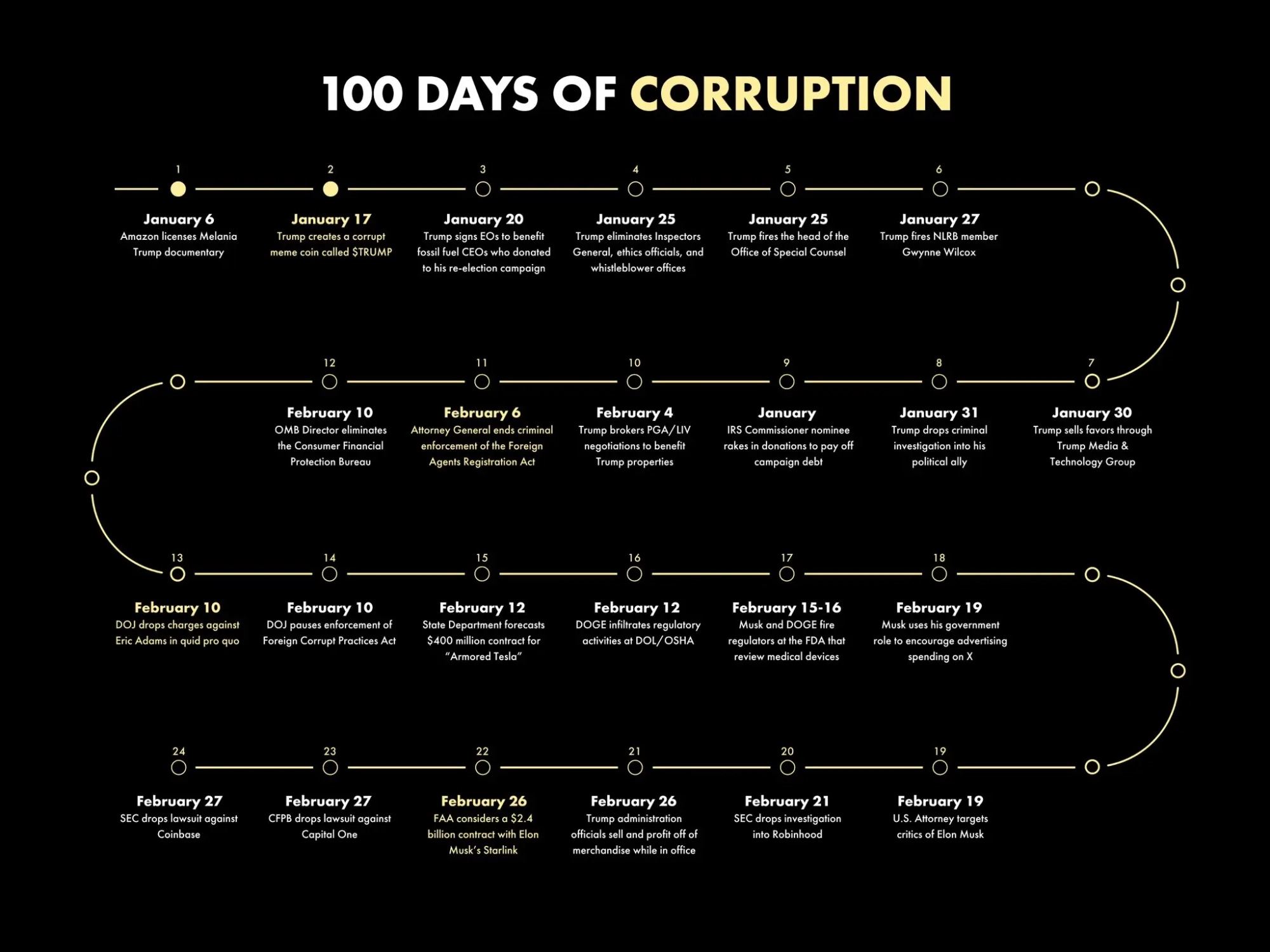
You can also click here to see an interactive from the Democracy Labs that allows you to click on icons to learn about 20 reported Trump Grifts to learn more about them.

Shareables for Kids
TED-Ed’s Democracy Lab is a great resource for parents and teachers looking for a way to lead into talking about present-day political issues. They also provide additional resources for teachers who want to use the videos in their classrooms. You can view the videos on YouTube or straight from the TED-Ed website.
This TED-Ed video corruption in the modern era, without setting off alarm bells for nervous school districts.
Shareables for Folks Who Only Watch Fox News
Because it’s under the Fox News Network branding, Fox Business News is seen as credible by many conservative and pro-Trump viewers. But, since it focuses more on economics and policy than on culture war issues, it may be a good source to look to when trying to reach across the aisle. If someone hears about corruption or conflicts of interest from a source they trust, especially one that emphasizes how it could hurt their wallets or communities, they may be more open to rethinking what’s happening.

Here’s an article about the original release of the $Trump Coin that echos some of the same data from other news sources about the personal financial benefit to Trump and his family, and potential conflicts of interests:
President-elect Trump launches own cryptocurrency meme coin ahead of inauguration
You might also look for coverage from right-wing news sources that include audio or video of Trump speaking in his own words.
Here’s an article and video of Trump stating, in 2021, that cryptocurries seem like a scam, hurt the US currency, and should be highly-regulated:
Trump warns crypto ‘potentially a disaster waiting to happen’
Self-Check
Audit Yourself
You may now complete a short quiz on this topic. Please answer honestly, ironically, or while muttering “we live in a society.”
.
Cool Down
A Corrupt Little Ditty
To wrap things up, enjoy this short and sharp retelling of Boss Tweed’s downfall, performed by actor and author John Lithgow. It’s based on his book A Confederacy of Dumptys, which turns the worst moments in American political history into pointed poetry. This one’s about Tweed, his rise, his theft, and the team effort that finally exposed him.
In the end, it wasn’t wealth or power that took Tweed down. It was an honest auditor, a relentless cartoonist, and the courage of a free press.